Plan Your Trip
High water happens, mostly from October to December, usually for a few hours. Here is how the sirens work, which sestieri flood first, and where to buy boots.
TLDR
Acqua alta is a predictable tidal event that briefly floods the lowest parts of Venice, mostly St Mark’s Square. It happens most often from October to December, lasts a few hours, and recedes on its own. Since the MOSE barriers began operating in 2020, major flooding has become rare. Check the forecast at comune.venezia.it each morning, buy 10 to 20 euro rubber boots near the station if needed, and carry on.
Insider Tip
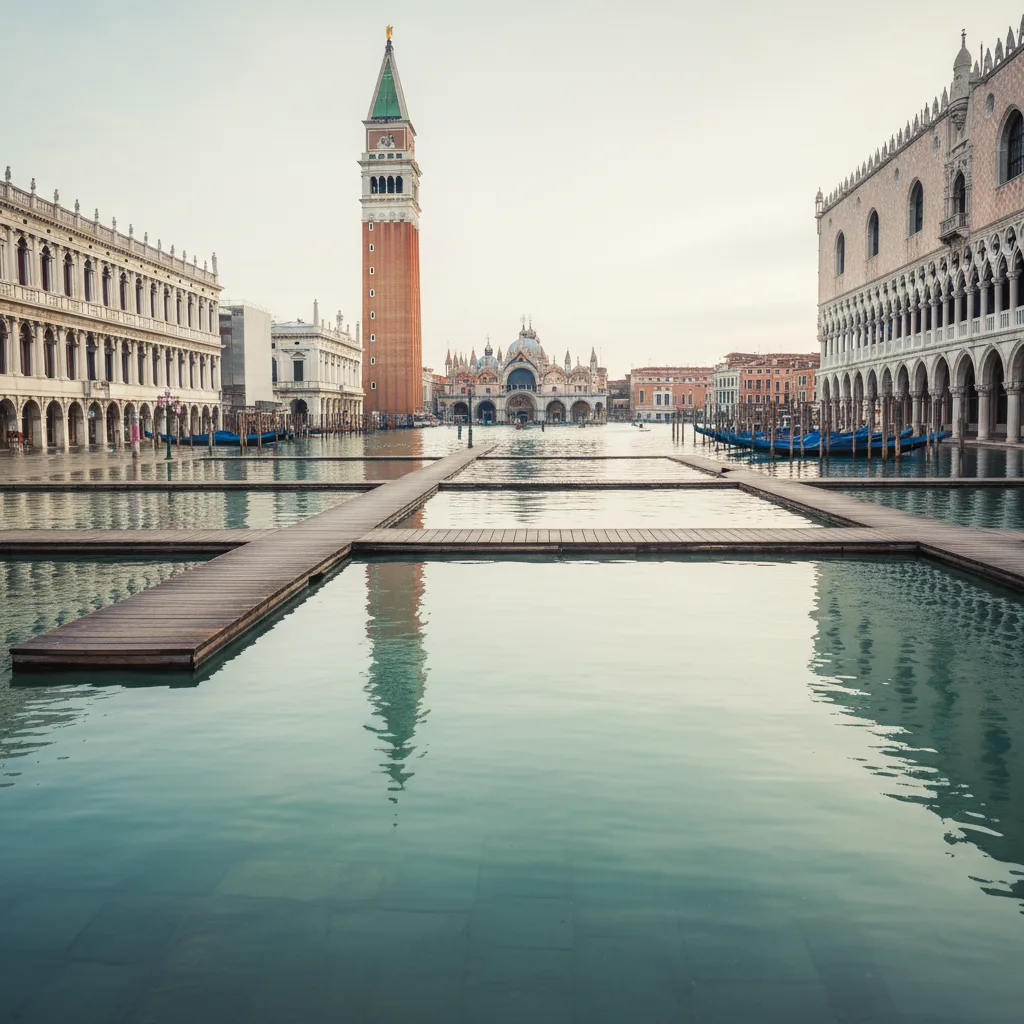
If a forecast predicts 110cm or more, plan your morning around it. Go to St Mark’s an hour before the peak, when the water is shallow and the reflections make the best photo of your trip. Then retreat to a sestiere two metres higher (Cannaregio, Dorsoduro’s centre) for coffee.
What acqua alta actually is
Acqua alta means “high water.” It is a tidal event, not a weather emergency. A combination of a normal high tide, a south-easterly sirocco wind pushing water up the Adriatic, and low atmospheric pressure can raise the lagoon by 80 to 140cm above datum. When it crests 80cm, the lowest parts of St Mark’s Square take a few centimetres of water. At 110cm, about 12 percent of the city is wet. At 140cm, closer to 60 percent. The peak lasts 1 to 3 hours and then recedes.
How the sirens work
The civil defence system uses a single tone followed by a number of short beeps to signal the expected height. The system is sounded 3 to 4 hours before the peak.
- 1 beep: expected peak 110cm or more. St Mark’s Square gets a few centimetres. Normal life continues.
- 2 beeps: 120cm or more. Low-lying calli in San Marco and west Castello may take 10 to 20cm.
- 3 beeps: 130cm or more. Raised walkways (passerelle) go up across the centre.
- 4 beeps: 140cm or more. Significant flooding. Vaporetto services may suspend at low bridges. Expect passerelle on most main routes.
Since MOSE has been operating, the barriers are raised whenever a forecast exceeds about 110cm, so the two, three and four beep events have become rare.
Which sestieri flood first
| Area | Threshold | What it looks like |
|---|---|---|
| St Mark’s Square | ~80cm | Lowest point in the city; floods first |
| Pescheria, Rialto Mercato | ~100cm | Main market square takes water |
| Calle Larga XXII Marzo, Mercerie | ~110cm | Main shopping streets take 5 to 15cm |
| Fondamenta along Grand Canal | ~120cm | Some pontili become step-free into shallow water |
| Cannaregio north | ~130cm | Interior calli still mostly dry |
| Dorsoduro central spine | ~135cm | Higher ground; often stays walkable |
| Giudecca, Lido | ~140cm | Generally higher than the historic centre |
Checking the forecast
The city council’s Centro Maree publishes a daily three-day forecast at comune.venezia.it/en/tide-forecast. The page gives the predicted peak height in centimetres and the exact time. The “Hi Venice” mobile app from the city council pushes alerts in English. The public WhatsApp service also sends two-hour advance warnings.

Boots, passerelle, and moving around
If your forecast shows 110cm or more, buy a pair of stivali (rubber boots) for 10 to 20 euros. The shops around Santa Lucia station, Piazzale Roma and Campo San Bartolomeo stock them in every size from October. Pack your own wellies if you have them and you are travelling in late autumn, but don’t buy expensive fishing boots at home; the city shops sell basic over-the-knee plastic boots that do the job for a few hours.
The passerelle are raised wooden walkways set up on main routes at about 130cm. They run in one direction at a time to avoid bottlenecks and are signposted. Vaporetto services may re-route at extreme peaks because the boats cannot pass under certain bridges. Check the ACTV line status on the Hi Venice app.
What this means for your booking
A single acqua alta event rarely disrupts more than a few hours. Damage to ground floors of older hotels happens occasionally and most hotels have flood barriers at the entrances. Picking a ground-floor room in a flood-prone building is a trade-off. If you are anxious about it, pick a hotel on the first floor or higher, or in a sestiere that sits higher than San Marco. Cannaregio, Dorsoduro’s central spine, Giudecca and the Lido are the least affected.
The MOSE era, briefly
MOSE (Modulo Sperimentale Elettromeccanico) is the sea barrier project at the three lagoon inlets. It has been used operationally since October 2020. The project stops the peak from arriving: when a forecast exceeds the threshold, the gates are raised and the lagoon is sealed off for a few hours. The system cost roughly six billion euros, has had its share of political issues, and does not solve gradual sea-level rise. But it has meaningfully reduced the number of disruptive flood events. For day-to-day travel, MOSE means the 110cm event you might have hit in November 2018 is probably prevented in November 2026.
Practical close
Don’t cancel a November trip over acqua alta. Do check the forecast each morning, keep an extra pair of socks in your bag, and read our when to visit guide for the wider autumn picture.
Common questions
When is acqua alta season in Venice?
Most events happen between October and December, with a smaller window in February and March. Summer acqua alta is rare but possible in sustained sirocco weather.
Does acqua alta happen every day in November?
No. In a typical November you might see three or four events of 80cm or more, and one or two of 100cm. Since MOSE, events above 110cm are much rarer than they were before 2020.
Is Venice flooding dangerous?
Shallow acqua alta is an inconvenience, not a danger. The water is clean lagoon water, about 3 to 15cm deep on the lowest squares, and recedes in two to three hours. The only real risk is slipping on wet bridge steps.
Do vaporetto services stop during acqua alta?
Only at extreme peaks (around 140cm). Boats may be re-routed because they cannot pass under some bridges. The ACTV status page and the Hi Venice app post real-time updates.
Where do I buy boots for acqua alta?
Shops near Santa Lucia station, Piazzale Roma, Campo San Bartolomeo and along Strada Nuova in Cannaregio sell over-the-knee rubber boots for 10 to 20 euros from October onwards. They are cheap, they do the job for an hour or two, and you can throw them away at the end of the trip.
Will MOSE prevent all flooding?
No. MOSE is triggered at thresholds above about 110cm, so minor acqua alta below that level still reaches St Mark’s Square. It reliably stops the disruptive 130cm and 140cm events that used to hit a few times each winter.